The Uttermost Part of the World
Tierra del Fuego (Land of Fire) is a large island off the southern coast of mainland South America. In Patagonia and Latin America it is called "Fin del Mundo" (literally End of the World) and refers to land's end of the continent of America. To reach this last refuge of humanity you cross the Straits of Magellan on a ferry boat. The waters earned a reputation for being treacherous and many ships and boats lie at the bottom of the Straits giving testimony to its dangerous navigation. Tierra del Fuego is split between Chile and Argentina. Ushuaia is the Argentine capital and is the southern most city in the world and our ultimate destination.
Tierra del Fuego: When Magellan sailed through the Straits he saw smoke and
campfires from native tribes on the island & named it "Land of Fire"
Island of Tierra del Fuego and Ferdinand Magellan's route of navigation
Photo of a photograph of Pachaeoli and her husband
(in Fin del Mundo Museum, Ushuaia), a Yamana couple,
one of four original cultures that are almost
extinct from Tierra del Fuego
Photo from Fin del Mundo Museum: These indigenous tribes
were encountered by Magellan & subsequent explorers
_________________________________
Navigating the demonic Straits of Magellan*
“We’re going to fall off the edge of the world!” shouts Crazy Juan.
“Not if we drown first or are frozen to death in these evil frigid waters,” responds the Old Salt.
Ferdinand Magellan hears everything. He feels his control of the fleet slipping. That frightens him more than the hellish 100 miles per hour winds, more than the 20 foot waves, or the too many to count leaks in the hull of his flag ship. He knows this raging strait of dark blue water leads to the calm sea of the Pacific Ocean. But, how much longer?
Sixteenth century portrait of Ferdinand Magellan, credited with
being the first to navigate the Straits and circumnavigate the world
The slashing wind and waters of the Straits on a "calm" day in October 2014
He risks all. The decision he makes will either condemn him and the loyal few to a bitter icy, watery death, or will save all souls aboard his three ships. Magellan commands, “Lower the lifeboat. Jesus gather the faithful twelve. We will lead the way in the small craft.” His breath hanging like a cloud in the freezing cold air.
Jesus is too cold and stiff to respond. He is not sure if he’s alive and dreaming a nightmare or he’s dead and condemned to a hell of his worst fears -- out of control winds, waves towering over the fifteen foot bow, and blindly sailing into the unknown. His navigational skills have failed him. Magellan assumes the howling of the wind blowing from the West and then changing to blast even stronger from the East, caused his voice to be carried away from his most loyal shipmate. He shouts again, “Jesus! Gather the warmest gear we have and give it to the twelve. We sail in the small craft to find the way to our salvation.”
Nineteenth century painting of the three remaining ships of Magellan's
fleet of five beginning their passage through the Straits
At the sound of this name, echoing with desperation, Jesus snaps out of the tempest spell, and is living in the moment again. He’s a mariner, has been since six years old, almost the entire forty years of his life. He reacts without thinking, grabbing ropes, shouting orders, shaking sailors out of near death stupors, unlocking wooden chests where the moth eaten rain gear is safeguarded. He does not question his captain. He cannot. It would go against every fiber of his body and soul. To survive the fury of the ocean takes the whole crew working together under one command. Refusing is not an option. Following directives, giving orders, focusing on battling nature’s rage is what he will do until his last breath. If that moment comes today, so be it!
There are worst things then death, something he’s been expecting all his life. He’s been fortunate to escape it time after time. Suffering dishonor and embarrassment of being a coward is too much to bear. If his time comes to see his maker, he goes with honor and looking straight ahead with eyes wide open, fighting to the end to save his vessel, his comrades, and his captain.
“Sir, all is ready. I await your command,” reports faithful Jesus from the main deck, now calm and ready for action.
Magellan's plan was to lead the fleet through the Straits
in a twelve foot lifeboat in order to determine a safe course,
avoid running aground and channels not leading to the Pacific Ocean
On the bridge, Magellan turns to his second in command to let him know the plan. A good man whose only fault is a lack of initiative. He will not abandon his comrades. He’s not creative enough to conspire such a scheme. He’ll pursue Magellan and the small boat. If it’s capsized or overwhelmed by the freezing waves, he will attempt a rescue. He will fight to hold on to control of the ship, even if the rest of the fleet abandons him, until he’s killed by mutineers. Those rebel sailors will be next to die. None of them have sufficient skills in navigation to return to the entrance of the straits or to sail to Spain.
“Lower the boat! We commend our worthless souls to the Lord,” shouts Magellan over the roar of the gale winds. Silently he wonders if that’s the last order he will ever give. He proudly, without showing that he’s freezing cold, with no feeling in his numb hands and feet, enters the lifeboat as a fifteen foot wave of ice cold water splashes everyone and soaks everything in the last remaining launch . . . .
Seventeenth century painting of Magellan leading the way in the lifeboat
For three days Magellan and his loyal crew row out in front of the flag ship leading the way out of the straits. Day after day the crew experience hardship and expect death, with feet, hands, ears, faces numb with unbearable cold, wrenching stomachs, uncontrollable bowels, stench from soiled pants, but all beaming with pride knowing that their heroic act, if successful can save the ships and all hands aboard. Before entering the small 12 foot craft they give thanks to the Almighty and swear that this will be their last voyage. Of the 150 mariners present on the three vessels that day to bear witness to unspeakable terror and panic being overcome by courageous love of fellow man, only 18, two who were in the small craft with Magellan, will reach home to keep the promise to never sail the turbulent high seas.
- Imagined historical narrative inspired by & written while crossing the treacherous Straits of Magellan
_________________________________
Imperial Cormorants patrol the Straits
On the way to Tierra del Fuego you cross the great Patagonian Pampas,
thirty hours on a bus and you see little variation of this landscape
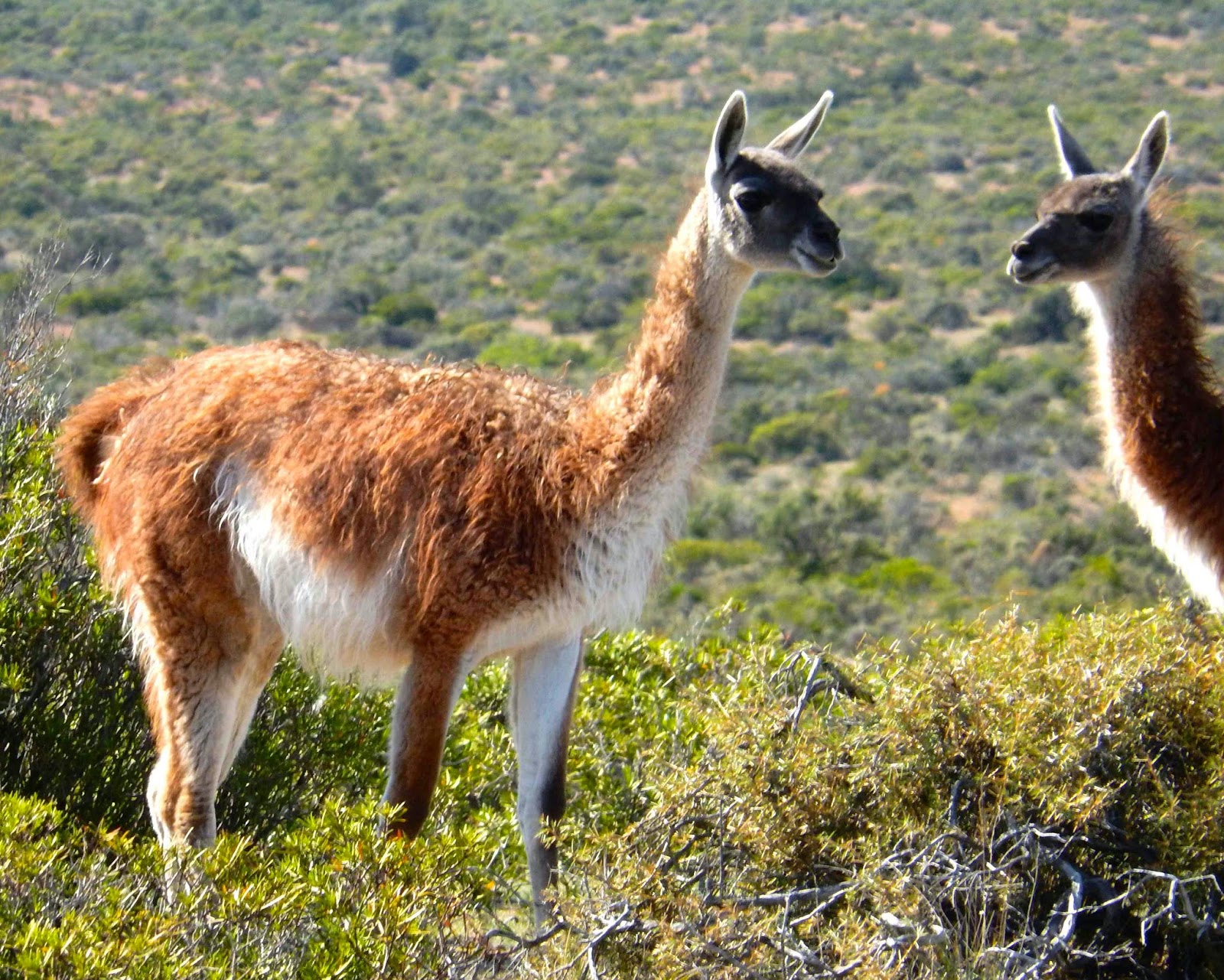
Birds and guanacos (wild relatives of the llama) roaming free in Patagonia
Guanaco herd grazing on native grasses and shrubs
To survive in harsh, dry climates, guanacos have a remarkable
ability to conserve water and obtain moisture from plants they eat
The End of an Adventure, The beginning of Understanding It
After three years, over 30,000 miles travelled, thirteen countries, countless bus rides, eating worms and living with head hunters in Ecuador, enjoying big black ants for dinner and finding "El Dorado" in Colombia, living with and learning from Sandinistas in Nicaragua, being robbed in Mexico, outrunning thieves in Guatemala, hiking to the top of the world and experiencing high altitude sickness in Bolivia, getting lost in and eaten alive by insects in Panama, accepted as being imparted with a little Mapuche spirit in my soul in Chile, seeing a natural wonder of the world, Iguazú Falls, in Argentina . . . . We have finally reached "Fin del Mundo", end of the Americas, Ushuaia, Tierra del Fuego - Land of Fire.
Fin del Mundo: Ushuaia, Argentina, we reached our destination in a snowstorm
Dramatic setting of Ushuaia; Antarctica is the next large land mass south of this location
I feel excited, thrilled, accomplished, proud, confident, exhilarated and most of all tired and relieved. I'll need to muster energy to get back to the USA. There are still hazards ahead as I travel north through Chile on my way back to California.
Magellan penguin colony of 190,000 during mating season
in Punto Tomo, Argentine Patagonia
A penguin couple prepared for mating, that hole in the background
is their nest & where they have & raise their offspring
Magellan penguins are not threatened by humans,
and graciously poise for photos . . . smile
Contrary to what is commonly believed the "end of the world" is not blazing hot and fiery . . . . it's cold, with a bone chilling wind trying to blow you off your feet. I'm loving it. With five layers of clothing I'm feeling warm.
Martial Glacier, Ushuaia, Tierra del Fuego, seeing it before it melts
As I look out to where the America's end, over the Beagle Channel, I feel I'm a million miles from home. After the jubilation, my first thoughts are of my family and friends, particularly those who have followed me on this adventure, provided encouragement, moral support, and lifted my spirit when it was desperately needed. I felt your presence and it moved and inspired me. This morning I was on cloud nine beaming with having reached a long sought goal. Now, I'm longing to see familiar bright smiles and hear boisterous laughter of family and friends.
We humans are a fickled species never completely satisfied and always wanting to see what's on the other side of the mountain or sea or border. After a few days rest in Tierra del Fuego, we're off to Chile on our return journey to California and to continue dreaming, exploring, and seeing: What's on the other side of that mountain?
_________________________________
Seafood of Tierra del Fuego is excellent!
The best calamari and king crab bowl I've ever savored
(La Casa de los Mariscos, Ushuaia)
Salmon and jumbo prawns stir fry;
freshest seafood I've ever feasted on
Only king crab please . . . it was plentiful and relatively inexpensive
Due to great distances of bus travel, there are two bus drivers who rotate,
Lucas finished driving six hours & on a break; we discussed Ché the revolutionary,
and he insisted on showing me his tattoo
Lucas designed and drew this image of Ché, it now graces his left shoulder;
others on the bus seized the opportunity to snap some photos
Manny at land's end, Tierra del Fuego, enjoying the view over the Beagle Channel